
Is Pilates Good for Back Pain?
Is Pilates Good for Back Pain? Back pain is one of the most common reasons people come to UNA. And one of the most common reasons people hesitate to start.
Is Pilates Good for Back Pain?
Back pain is one of the most common reasons people come to UNA. And one of the most common reasons people hesitate to start.
The hesitation makes sense. If your back already hurts, the last thing you want to do is make it worse. But for the vast majority of people, the right kind of movement is exactly what the back needs. The problem isn't movement. It's the wrong movement, repeated for too long, without correction.
That's precisely what Pilates addresses.
Why Most Back Pain Starts with How You Move
Chronic back pain rarely has a dramatic origin. It builds quietly, through years of sitting in the same position, moving in the same patterns, and loading the same structures in the same way. The back gets tight where it should be mobile. Weak where it should be strong. And eventually, it lets you know.
The muscles that support the spine, the deep stabilisers, the muscles around the pelvis, the postural muscles that hold you upright, are exactly the muscles that modern life systematically underuses. Pilates targets all of them, directly and precisely.
What the Research Says
Multiple clinical studies have found Pilates to be effective in reducing chronic lower back pain, improving function, and decreasing disability. A 2015 systematic review published in the Journal of Orthopaedic and Sports Physical Therapy found Pilates to be superior to minimal intervention for pain and disability outcomes.
This isn't surprising. Pilates was originally developed as a rehabilitation method. The principles that make it effective for general fitness, controlled movement, precise loading, attention to alignment, are the same principles that make it effective for back pain.
How Pilates Helps Back Pain Specifically
At UNA, we work with clients with a wide range of back conditions, from general tension and postural issues to scoliosis, disc problems, and post-surgical recovery.
What we find, consistently, is this: when the deep stabilisers are properly engaged, when the pelvis is correctly positioned, and when movement is distributed through the whole spine rather than concentrated in the same segments, pain decreases. Not because we've treated the pain directly, but because we've addressed what was causing it.
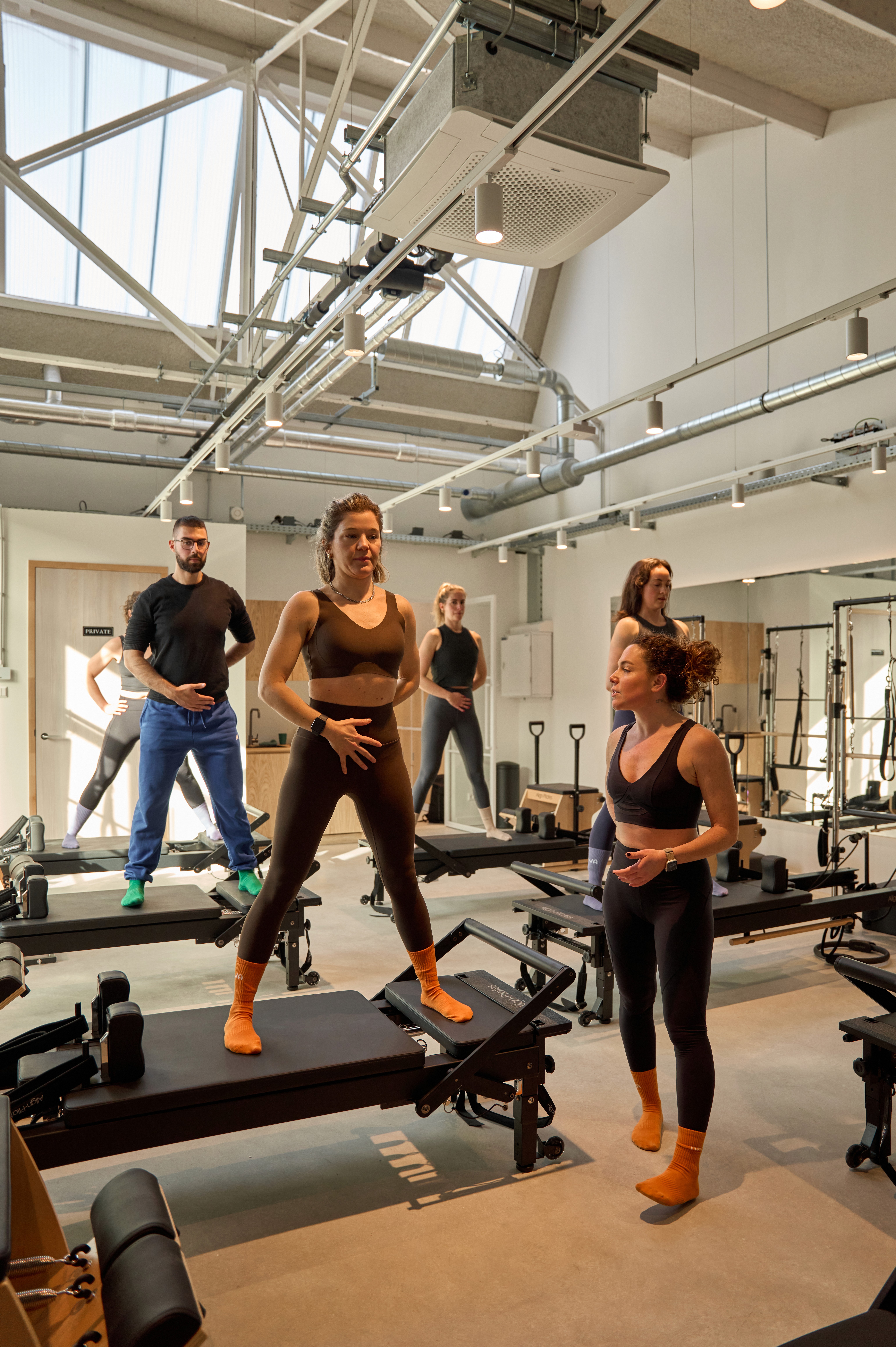
The Reformer, Half Cadillac, and Chair each offer different ways to support, decompress, and load the spine. This matters because back pain is not one thing. A great teacher uses the full equipment system to address your back specifically, not a generic back pain protocol.
What to Tell Your Teacher Before Class
If you're coming to UNA with back pain, tell us. Tell us where it is, what makes it worse, what makes it better, whether you have a diagnosis. This isn't background information. It's how we make sure every exercise in your class is working for your back, not against it.
Our small group sizes exist precisely for this reason. Your teacher can see you, correct you, and modify in real time. That level of attention is what makes the difference between Pilates that helps and Pilates that doesn't.
A Note on Acute Pain
If you're in acute pain, rest first. Pilates is not a crisis intervention. But once the acute phase has passed, building the strength and movement quality that prevents recurrence is exactly where we come in.
Most people who come to UNA for back pain don't just feel better. They understand their back better. They know what caused the problem and what keeps it away.
That knowledge is worth more than any single treatment.
Book your first class at UNA: unapilates.com
More Posts
Newsletter

Premium Pilates studio dedicated to helping you build strength, flexibility, and mindfulness.
Contact
info@unapilates.com
+31 627901913
Pilotenstraat 11B-C
Amsterdam